Does Lettuce Before Bed Actually Help You Sleep?
The TikTok lettuce water trend has a real compound behind it. What lactucin actually does, what the 2017 study showed, and three bedtime helpers with stronger human evidence.
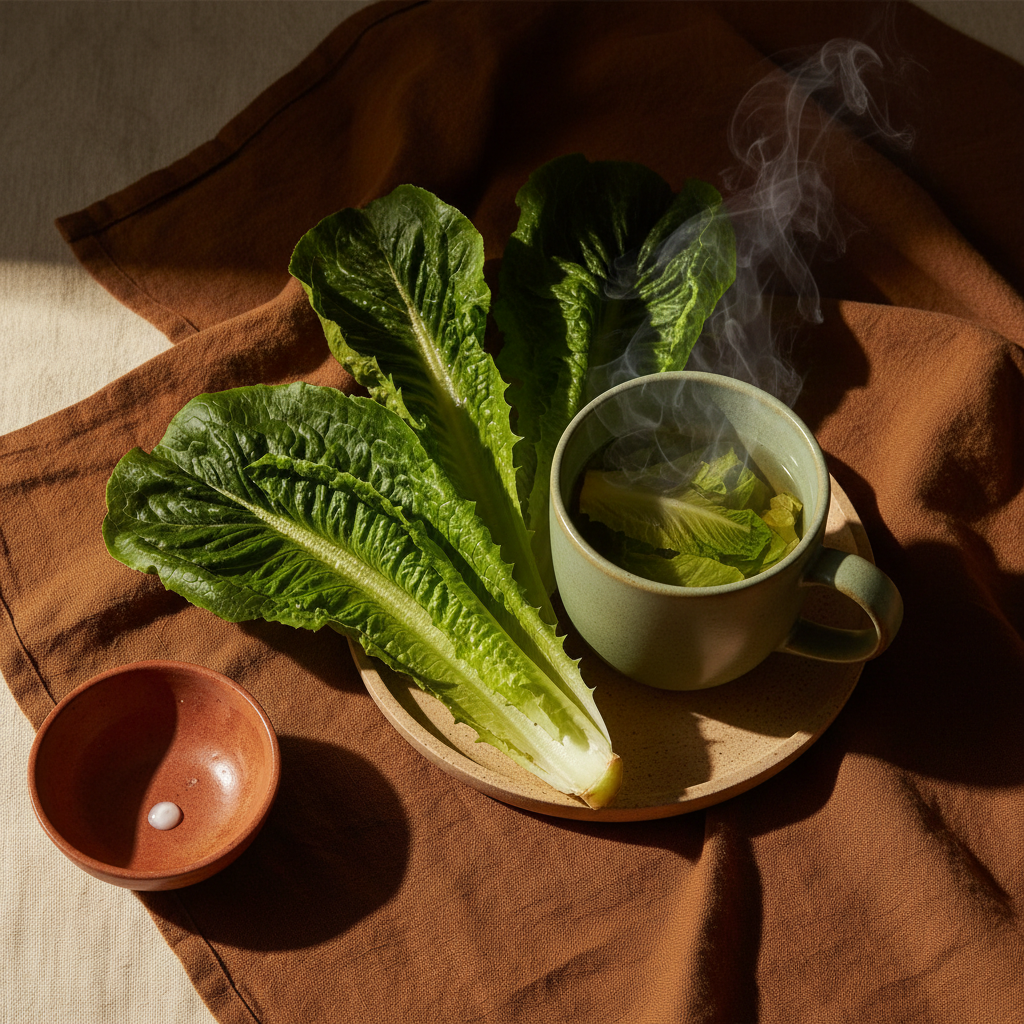
The first time the lettuce before bed sleep trend went viral on TikTok, the video racked up seven million views in a fortnight. The setup: tear a few leaves of romaine into a mug, pour over boiling water, steep for ten minutes, drink before bed. The promise: a sedative tea hiding in plain sight in the supermarket salad aisle.
The trend keeps coming back because there is a real compound behind it. Lettuce, particularly the wild and bitter varieties, contains a substance called lactucin that has been studied for its sedative properties since the nineteenth century. Whether the amount in a supermarket romaine head is enough to do anything noticeable to your sleep is the question this guide answers, and where the stronger evidence sits if you want a meaningful change tonight.
If you want a complete twelve week sleep rebuild covering circadian light, supplements, the bedroom audit and the wind down that has the strongest evidence behind it, the Sleep Fix Protocol is the comprehensive version. Unlock it free.
How Did Lettuce Become a Sleep Trend?
Lettuce became a viral sleep aid because TikTok rediscovered an old herbal idea and dressed it up as a hack. The original folk use traces back to ancient Egyptian and Roman texts, where lettuce, particularly wild lettuce (Lactuca virosa), was prescribed for restlessness and pain. The sedative reputation persisted through nineteenth century pharmacopoeias, where dried wild lettuce sap, called lactucarium, was sold alongside laudanum as a milder alternative.
Modern romaine and iceberg are descendants of wild lettuce, bred for size and crunch rather than bitterness. They contain a fraction of the active compounds their wild cousin does. The TikTok trend caught fire because it tapped a recognisable food, a real history, and a believable mechanism, exactly the combination that goes viral. What the videos rarely mention is how much lettuce the research actually used, or that almost all of it was in mice.
What Does Lactucin Actually Do?
Lactucin is a sesquiterpene lactone, a bitter compound produced by the lettuce plant as a defence against insects. Its sister compound lactucopicrin sits alongside it in the milky sap that seeps out of a cut lettuce stem. Both are concentrated in wild lettuce, present in much smaller amounts in romaine, and almost absent in iceberg.
The proposed mechanism is GABA mimicry. Lactucin and lactucopicrin appear to bind weakly to the same brain receptors that benzodiazepines and alcohol target, producing mild sedation and reduced anxiety. The binding is far weaker than a pharmaceutical, but the principle is the same: gentle suppression of central nervous system arousal.
Lactucin has also been studied for analgesic effects. A 2006 paper in the Journal of Ethnopharmacology found that lactucin and lactucopicrin reduced pain response in rodents at doses comparable to mild paracetamol. None of this work has been replicated in humans at meaningful scale, which is the recurring caveat with every claim made about lettuce and sleep.
Does Lettuce Before Bed Really Help You Sleep?
Lettuce before bed has a mild calming effect for some people, but the evidence base for a meaningful sleep change in humans is essentially absent. The most cited study, the 2017 Korean romaine work, used mice and a concentrated extract at doses that translate to amounts no human would eat. A normal serving of lettuce before bed gives you a dose of lactucin so small it sits well below any threshold tested in research.
That does not mean lettuce water does nothing. Warm fluid before bed, a quiet ritual, and a slight bitter taste that signals “end of day” all matter for sleep onset, regardless of the chemistry. The combination of the act and the placebo response is genuine. What is misleading is the framing that lettuce contains a meaningful natural sedative that you can dose with a salad bag. The evidence does not support that.
If you are struggling with falling asleep, the better starting points are covered in our complete guide to fixing your sleep and our magnesium for sleep and anxiety guide, both of which lean on stronger human trial data.
What the 2017 Romaine Lettuce Study Actually Showed
A 2017 study at Sahmyook University in South Korea, published in Food Science and Biotechnology, fed mice extracts from green and red romaine lettuce, then induced sleep with pentobarbital and measured how long the animals stayed asleep. The red romaine extract, which had the highest concentration of phenolic compounds, extended sleep duration by roughly 30 percent compared to the control group. Researchers concluded that lettuce extract had measurable hypnotic effects in this animal model.
Three things matter when reading that result honestly. First, the doses were extreme: scaled to human bodyweight, the active dose would be the equivalent of around three large heads of lettuce per kilogram of bodyweight, taken as a concentrated extract. No human is eating that. Second, the test required pentobarbital, a sedative drug, to induce sleep in the first place. The lettuce extract amplified an existing drug effect rather than initiating sleep alone. Third, mice and humans process sesquiterpene lactones differently, and the GABA receptor binding affinity in humans has never been directly measured.
The study is real and the finding is interesting. It does not prove that eating a salad before bed will help you sleep, and the TikTok videos citing it tend to leave out everything that would qualify the claim. Reading a single sensational study against what it actually shows, animal model, dose translation, mechanism gap, is the core skill of the Sable + Sand book.
Natural Sleep Remedies That Work Better Than Lettuce
If you want a bedtime intervention with stronger trial data, three supplements have substantially better evidence than lettuce, all with human randomised controlled trials behind them. None of them are exotic, all of them are widely available in the UK, and each addresses a different mechanism.
Ashwagandha (KSM-66) for Cortisol Driven Wakefulness
Ashwagandha is the supplement to reach for if your sleep problem is the wired but tired pattern: lying awake at midnight despite being exhausted, or waking at three in the morning unable to switch your brain off. The active version is KSM-66, a standardised root extract that has been used in most of the published trials.
A 2019 randomised double blind trial by Salve and colleagues, published in Cureus, found that 600mg of KSM-66 daily for eight weeks reduced morning cortisol by 27 percent and improved Pittsburgh Sleep Quality Index scores by a meaningful margin compared to placebo. A separate 2020 trial in Sleep Medicine showed reduced sleep onset latency in adults with non restorative sleep at the same dose. Ashwagandha is one of the more rigorously tested adaptogens for sleep, particularly where cortisol is part of the problem. If three in the morning wakeups are your pattern specifically, our piece on why you keep waking up at 3am covers the cortisol mechanism in more depth.
Shop NutravitaGlycine 3g Before Bed for Sleep Onset
Glycine is an amino acid that crosses the blood brain barrier and lowers core body temperature, one of the physiological signals the body uses to initiate sleep. It does not sedate. It works by helping the natural sleep entry process happen more efficiently.
A 2007 study by Yamadera and colleagues in Sleep and Biological Rhythms gave 3g of glycine to volunteers with mild sleep complaints, taken 60 minutes before bed. The glycine group fell asleep faster, reported better subjective sleep quality, and showed polysomnographic changes consistent with quicker entry into slow wave sleep. The dose used in the trial is unusually high for a single amino acid, which is why a teaspoon of glycine powder in water before bed is the practical format.
Shop NOW FoodsL-Theanine for Sleep Architecture Without Sedation
L-theanine is the calming amino acid found in green tea, available in supplement form at a much higher dose than tea can provide. A 2019 randomised controlled trial by Hidese and colleagues in Nutrients found that 200mg of L-theanine daily for four weeks improved Pittsburgh Sleep Quality Index scores and reduced perceived stress in adults with everyday stress complaints. Critically, theanine does this without inducing sedation, which makes it useful for people who want better sleep quality but cannot tolerate anything that makes them groggy.
For people whose sleep architecture is the issue, fragmented stages 3 and 4 rather than trouble falling asleep, apigenin at 50mg is a stronger alternative with research on GABA A binding directly. Both are evidence led picks for sleep depth rather than sleep onset.
Shop Doctor's BestFor people whose sleep architecture is more deeply disrupted, Shop Futuro Labs at 50mg is the deeper sedative option, with research showing direct binding to the same receptors that benzodiazepines target.
How to Try Lettuce Water Before Bed
If you want to try the lettuce ritual anyway, treat it as a relaxing wind down practice rather than a sedative. The compounds responsible for any sleep effect, lactucin and lactucopicrin, are concentrated in the bitter milky sap closest to the stem, so the leafy outer parts of supermarket romaine give the smallest dose. Wild lettuce tinctures, sold in herbal shops, have far higher concentrations and a stronger taste, but also a less predictable effect.
The standard ritual: tear five or six leaves of romaine into a mug, pour over boiling water, steep for ten minutes, optionally add honey or a slice of lemon for taste, drink an hour before bed. There is no clinical dose. The warmth, the bitter signal, and the act of slowing down are doing most of the work.
If you want to combine the ritual with something better evidenced, pair it with glycine in water or ashwagandha at the same time. The combined effect on actual sleep markers is more likely to come from the supplement than the lettuce.
When Lettuce Will Not Be Enough
Lettuce water will not solve the kinds of sleep problems that have a physiological driver behind them. Three in the morning cortisol surges, perimenopausal hot flushes that wake you sweating, sleep apnoea that fragments stages 3 and 4, or anxiety that loops the same thought every time you close your eyes are not problems a salad can address.
For cortisol driven wakefulness, our high cortisol guide maps the signs and the supplements with the strongest trial data. For hormonal sleep disruption in perimenopause, the menopause insomnia and sleep architecture guide goes deeper. For people who want one place that pulls all of it together, the Sleep Fix Protocol is the twelve week version.
The TikTok lettuce before bed sleep trend is a useful reminder that ancient herbal observations sometimes have real compounds behind them. It is not a substitute for the things that actually move the needle: light exposure, blood sugar control, magnesium where it is low, and the supplements with human trial data. Try the ritual if you enjoy it. Build the foundations regardless.
Frequently Asked Questions
Does lettuce before bed actually help you sleep?
Lettuce contains lactucin and lactucopicrin, compounds linked to sleep that bind weakly to GABA receptors. A 2017 study at Sahmyook University found romaine lettuce extract extended sleep duration in mice, but human evidence is absent. The effect on people is mild, food level at best, and unlikely to replace a meaningful sleep supplement.
How much lettuce do you need to eat to feel sleepy?
The 2017 romaine study used the equivalent of around three large heads of lettuce per kilogram of bodyweight in mice, an impossible amount for humans. Eating a normal salad or drinking lettuce water gives an effective dose that sits well below anything trialled. Realistic effect: relaxing, not sedating.
What is the best natural supplement for sleep?
Magnesium glycinate at 200 to 400mg has the strongest evidence for sleep onset. Ashwagandha at 600mg KSM-66 lowers cortisol and helps the wired but tired sleep pattern in randomised trials. Glycine at 3g taken 60 minutes before bed improved subjective sleep quality in a 2007 Japanese trial. L-theanine at 200mg supports sleep architecture without sedation.
Is lettuce water actually safe to drink before bed?
Boiled lettuce water is safe for most adults and unlikely to cause side effects. The compounds responsible for any sleep effect, lactucin and lactucopicrin, are present in very small amounts. For people on sedating medication or with low blood pressure, even a mild GABA effect may amplify drug effects, so check with a pharmacist.
How to Read Wellness
The book that taught us how to read every supplement label, clinical trial, and viral wellness claim. £24 paperback, printed to order.
Buy the bookProducts mentioned in this guide
Affiliate Disclosure
Some links in this guide are affiliate links, if you buy something we recommend, Sable + Sand may earn a small commission at no cost to you. We only recommend products we would genuinely use, and all editorial decisions remain entirely independent.